Game guide · YOUDIYOU
Rummy Hand Checker: how a round works
Work at your own pace. Check a 13-card Indian Rummy hand for a valid declaration and see its grouping and penalty. The same rule applies on a phone and on a computer. A clear plan starts with the current position. Enter 13 cards separated by spaces. Use A, 2–10, J, Q, K with S, H, C or D; use JK for a printed joker. Return to the explanation when a decision is unclear.
Rules match the Indian Rummy table on this site. This does not validate another app’s table settings.
A focus for your next round
Use the rule sheet as a reference. Enter the wild rank, using 1 for Ace and 11–13 for face cards. The same rule applies on a phone and on a computer.
Your goal
Check a 13-card Indian Rummy hand for a valid declaration and see its grouping and penalty. Return to the explanation when a decision is unclear. Before making a move, check the cards in view.
From the start of a round
- Enter 13 cards separated by spaces. Use A, 2–10, J, Q, K with S, H, C or D; use JK for a printed joker.
- Enter the wild rank, using 1 for Ace and 11–13 for face cards.
- Select Check hand. The tool checks every non-overlapping grouping under the stated two-sequence rule.
- Review the result, pure sequences and remaining cards. Duplicate suited cards may appear at most twice; at most two printed jokers are allowed.
Keyboard and screen controls
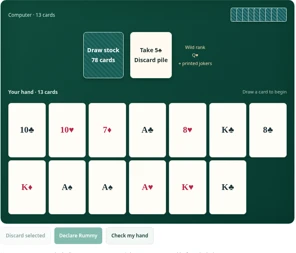
Type or paste cards, choose a wild rank and press Check hand. The sample can be edited. Return to the explanation when a decision is unclear. Before making a move, check the cards in view.
A closer look at one example
3H 4H 5H 7S 8S JK 9C 9H 9D KC KH KD KS with rank 2 wild is a valid declaration. Take the next action only when the current step is clear.
A mistake to avoid
Keep the active rule in mind. The wild rank changes which cards can substitute. Always set it before relying on the result. Take the next action only when the current step is clear.
Further help with the game
What is the aim?
Check a 13-card Indian Rummy hand for a valid declaration and see its grouping and penalty. A clear plan starts with the current position. Use another round to revisit a decision.
How do I use the controls?
Type or paste cards, choose a wild rank and press Check hand. The sample can be edited. Look at the complete hand before deciding. Return to the explanation when a decision is unclear.
Which format is available?
Rules match the Indian Rummy table on this site. This does not validate another app’s table settings. Take a moment to read the table. Use another round to revisit a decision.
What should I check before a move?
The wild rank changes which cards can substitute. Always set it before relying on the result. Before making a move, check the cards in view. Take the next action only when the current step is clear.
Can you give an example?
3H 4H 5H 7S 8S JK 9C 9H 9D KC KH KD KS with rank 2 wild is a valid declaration. Before making a move, check the cards in view. Use another round to revisit a decision.
Can I enter fourteen cards?
The checker accepts the 13 cards you would retain after discarding. Use the game for the draw/discard turn. A clear plan starts with the current position. The same rule applies on a phone and on a computer.
Does it evaluate all legal groupings?
It searches disjoint melds and never reuses a physical card in two groups. Before making a move, check the cards in view. The same rule applies on a phone and on a computer.
Are external app scores guaranteed to match?
No. Apps can use different rules. This checker follows the rule sheet on this site. A clear plan starts with the current position. The same rule applies on a phone and on a computer.
Do I need an account or an app?
No. Open the page in a JavaScript-enabled browser. No player account or APK is needed. Keep the active rule in mind. Take the next action only when the current step is clear.
Are these scores cash or prizes?
No. Points are used only for free play and practice. There are no deposits, cash stakes or withdrawals. Look at the complete hand before deciding. Take the next action only when the current step is clear.